
A Hand to Hold (2026)

-Written by Kyle Bain.
When Moira’s (Frances Barber) recently deceased husband gets a case of the rigor mortis, she’s unable to peel her hand away from his. Days go by, and stuck together they remain. As the impossible begins to happen, Moira questions reality—and A Hand to Hold explores the ramifications of challenging relationships and the grief that comes as a result of them.
What initially presents itself as a hard-hitting drama about death quickly shifts into the realm of comedy—dark comedy that is. Still focusing entirely on death throughout its fourteen-minute runtime, the dark, trying narrative is wrapped up in something far more lighthearted than initially expected. Rigor mortis becomes a focal point of A Hand to Hold, and the inability of Moria to physically separate herself from her late husband is the vehicle by which this comedy is delivered. A physical (albeit comical) representation of grief and the inability to separate yourself from a loved one presents viewers with something uniquely poignant and emotionally riveting.
A Hand to Hold is a horror film, but not in the typical sense (as is apparent by my previous commentary). It’s body horror, without an actual commentary on the unspoken rules and stigmas that surround the human body. What it ultimately becomes is something far more psychological. As it navigates this unique story, the film creates a sense of unease that is capable of haunting anyone watching. A Hand to Hold is a cautionary tale of our dependence on others. Much like the recent film Together, A Hand to Hold cautions against becoming reliant on others, and just as importantly, it cautions against relationships in which your partner is dependent on you. Neither is healthy, and the blend of comedy and horror makes this message abundantly clear from the start.
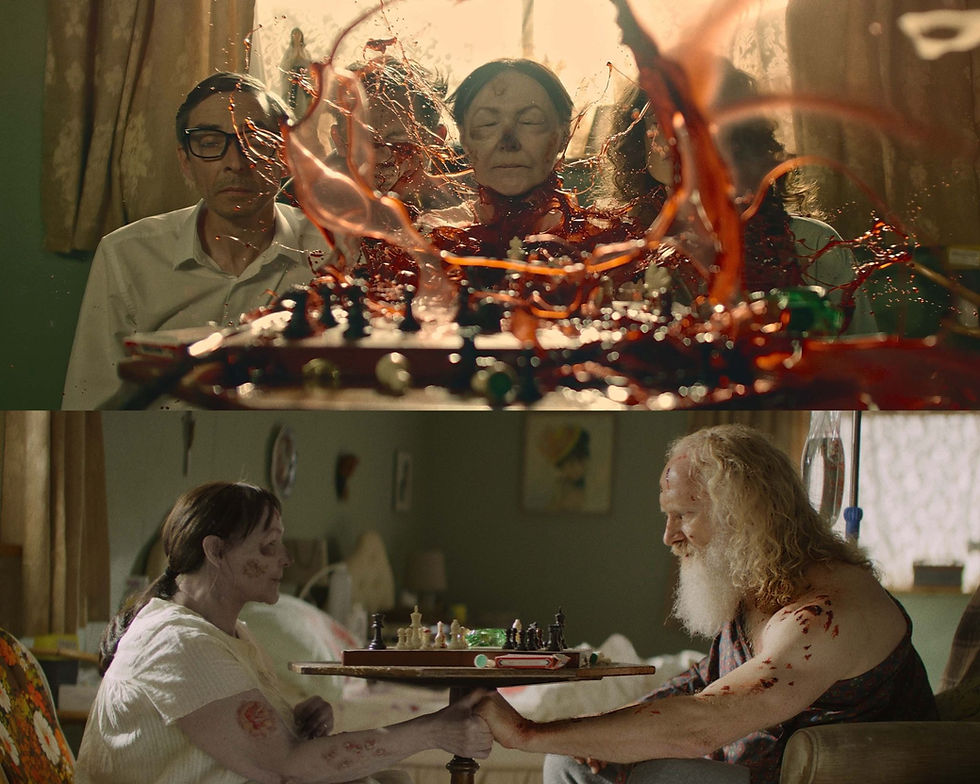
I found myself immersed in the ridiculousness of A Hand to Hold, while being able to, just as effectively, be moved by the meaning behind the insane stunts depicted on screen. The hyperbolic visuals, through the use of lighting, color, and cinematography, immerse viewers in this film. There is so much to behold, but given the often silly nature of the film, it’s certainly possible that the meaning becomes lost in the shuffle. By having the visuals burst from the screen, A Hand to Hold remains relevant and accessible–never forgetting its purpose, and making it easy for viewers to remain present in its purpose as well.
The level of intellect needed to master chess is something that has intrigued me for years. It’s a game, but it can’t be won by brute force; winning is completely dependent on your intellectual abilities. I’ve found it just as interesting when chess is included, in any fashion, in a film or television series–as it speaks volumes to (at the very least) what the writer(s) and director(s) hope to convey in their production. Opening the film to Moira and her husband, Patrick (Murray McArthur), playing chess immediately sets the tone for this short film. It’s made clear in that moment that A Hand to Hold won’t be a shut-your-brain-off sort of film, but rather one that tugs at your heartstrings, tantalizes your senses, and antagonizes the deepest depths of your brain.
A Hand to Hold is a brilliant concept wrapped inside of a wonky, but beautifully effective delivery. While the film deals with a very serious concept, its lighthearted approach makes A Hand to Hold more accessible and slightly more even-keeled. Writer Eliza Power and Director Philip Clyde-Smith do an excellent job of creating some level of balance, while still managing to be welcomingly aggressive in their approach.
Directed by Philip Clyde-Smith.
Written by Eliza Power.
Starring Frances Barber, Murray McArthur, Frank Bourke, Lisa O’Connor, Katherine Moran, etc.
8.5/10 = WORTH RENTING OR BUYING


Comments